
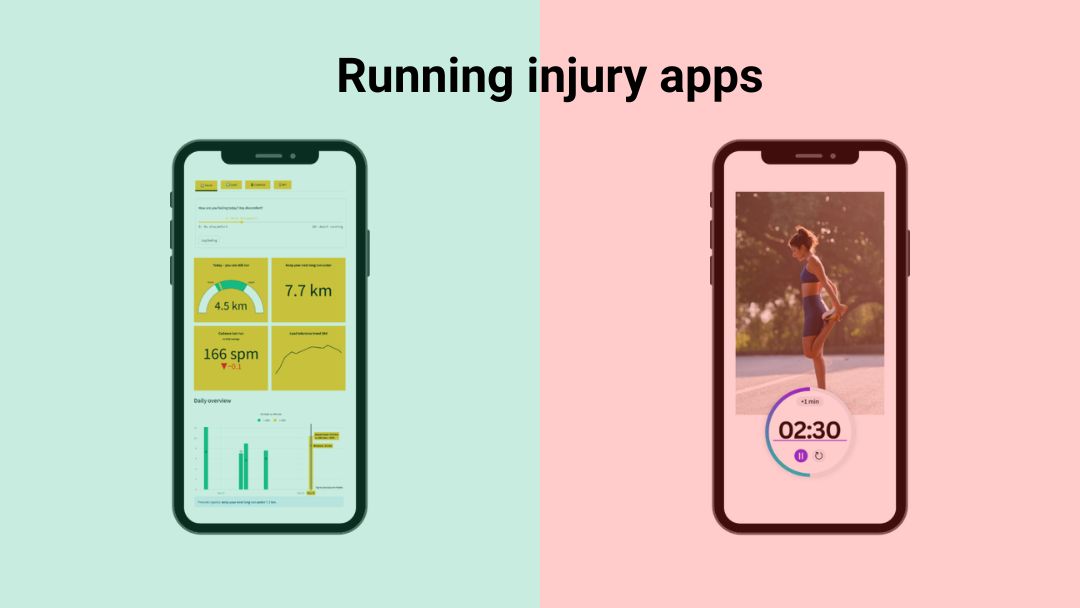
Let’s compare 5 running injury apps, so you know which one is best for you. We’ll cover: Recover Athletics (Strava), Exakt Health, Molab Run, myTrainingForecast, GaitLab.
“The best running injury app” depends on the goal you’re trying to achieve. So let’s jump straight to the section relevant for you:
- Injury prevention | You can run, but want to prevent injury (or prevent small issues from getting worse)
- Injury rehabilitation | You are injured, unable to run
- Return-to-run | You are slowly starting to run again, after injury
I’ve also added a bonus app for those who want to improve their running technique.
Exercise-based prevention programs (strength, mobility, plyometrics, stretching) show no significant reduction in injury risk or injury rate
(From a recent meta-analysis covering 1,904 runners)
The running injury apps we’re about to cover:
- Injury prevention and return-to-run
- Molab Run
- myTrainingForecast
- Injury rehab
- Recover Athletics (Strava)
- Exakt Health
- Running technique
- GaitLab
Running injury prevention apps
Preventing running injuries is not easy, and many running injury apps are built around a fundamentally flawed idea. They try to fix your running technique or stretch and strengthen your muscles.
But here’s the uncomfortable truth:
- Most running injuries are not caused by a poor technique, stiffness or a lack of strength, according to the literature.
- Exercise-based prevention programs (strength, mobility, plyometrics, stretching) show no significant reduction in injury risk or injury rate, according to a recent meta-analysis covering 1,904 runners.
Oops.
The scientific consensus is that most running injuries (70-80%) are caused by running too much, too fast, too soon. So if you want to prevent injuries, you need a running injury app that guides you in safely increasing running distance, which is harder than it sounds.
Because even though most runners know they need to build gradually, still 30-75% of runners get injured every year. That’s because we tend to focus on increasing mileage, while neglecting factors that co-determine the actual impact on our body, like running pace and running cadence. Here’s where the right running injury apps can help.
Running injury prevention apps that help you build up gradually and prevent overload:
Molab Run
Molab Run is a running injury app that helps you achieve your running goals, without getting injured. The app connects to your running watch, analyses your running data and gives you recommendations and workouts.
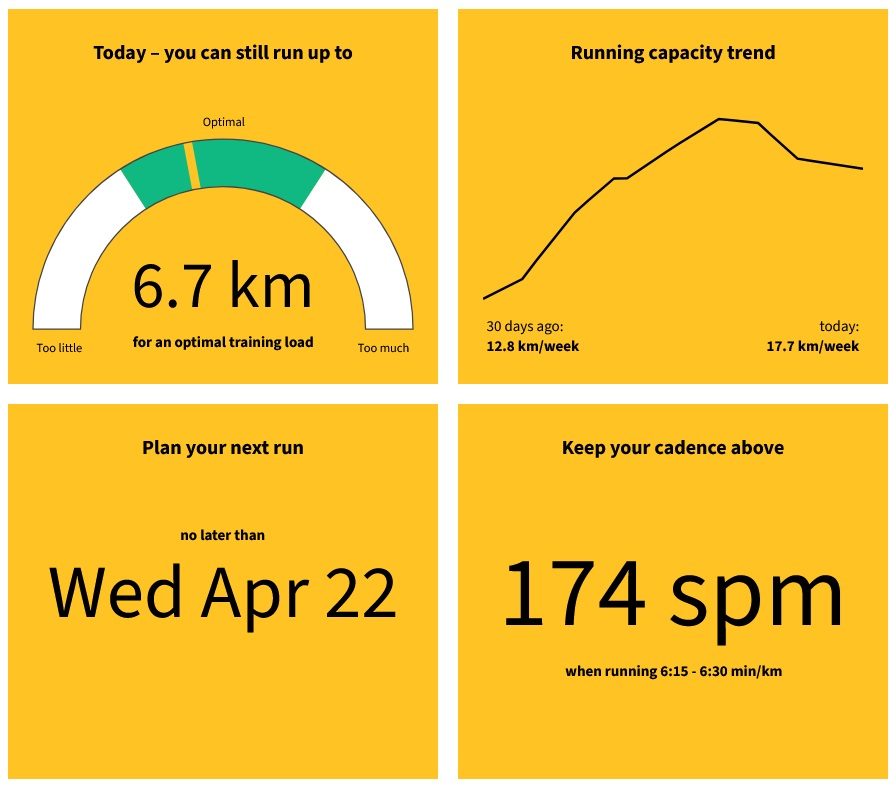
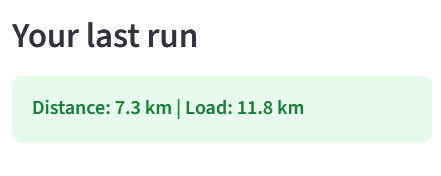
Here’s what makes it different from every other running load app: it doesn’t just count kilometers. It calculates impact load: the actual mechanical stress your body absorbed, adjusted for pace.
A fast 5km can cause significantly more load than an easy 10km. Molab Run takes that into account.
After following 5205 runners for 18 months, researchers finally found what’s the most common cause of running injuries:
A single (too) long run – not weekly changes.
A single run becomes ‘risky’ when it’s ≥10% longer than the longest run in the prior 30 days. Therefore, you need to focus on gradually progressing your long runs, instead of looking at weekly training volume only (old school 10% rule).
Molab Run helps you do exactly that, using impact load instead of plain kilometers:
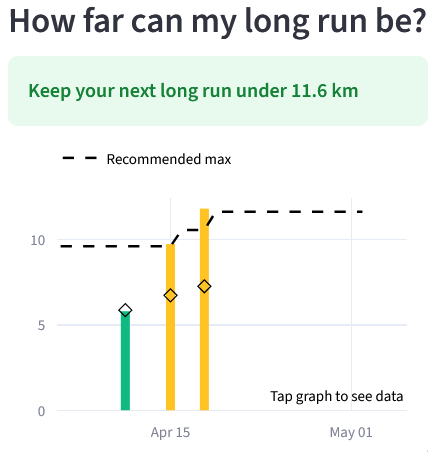
It looks at long term trends and single-session trends, to decide how far you can run, while staying in the safe zone. As a result, you can spot injury risks early, before it’s too late.
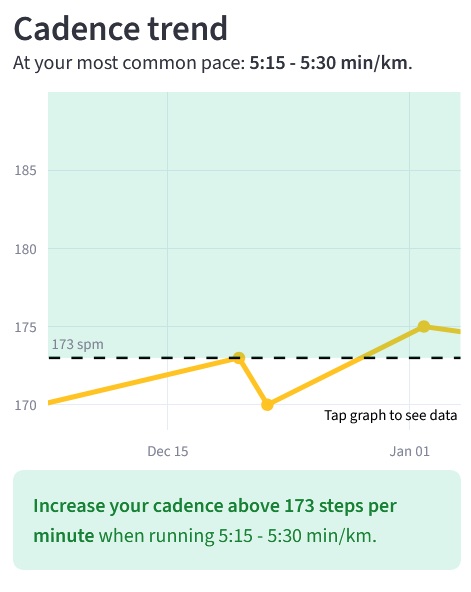
Another scientifically proven way to significantly decrease the running load is to increase your running cadence. However, running cadence depends a lot on pace. Therefore, Molab Run recommends a specific cadence for each pace you’d like to run. It also tracks cadence trends (at a specific pace) over time:
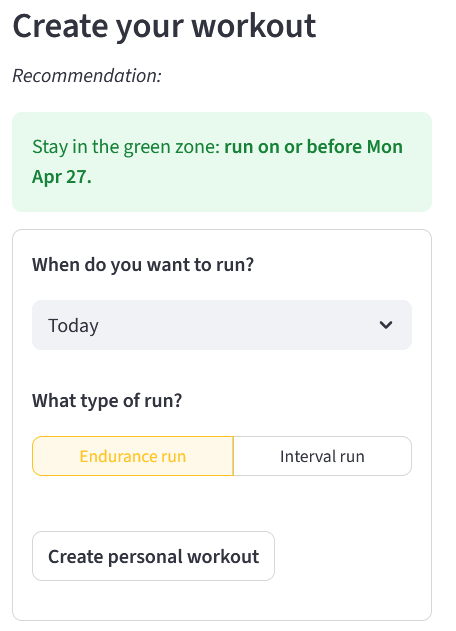
Ready to plan your next run? Create a run that keeps you in the safe zone:
There’s so much more you can do with Molab Run. Simply connect your watch to discover your own running data in action:
Platform: Web app | molab.me/run
myTrainingForecast
myTrainingForecast is somewhat similar to Molab Run. It uses your run data to monitor whether you’re not running too much.
Contrary to Molab Run, it counts your kilometers and does not adjust for pace. This means a fast tempo run and an easy recovery run of the same length, are treated equal.
The free version of the app uses the Acute:Chronic Workload Ratio (ACWR) to monitor your training load. The idea: divide your last week’s mileage by your average over the past weeks. If the ratio spikes, you’re at elevated injury risk.
There’s a problem though: recent literature shows that ACWR spikes are actually associated with a decreased injury rate. Not increased. The week-to-week ratio showed no relationship at all.
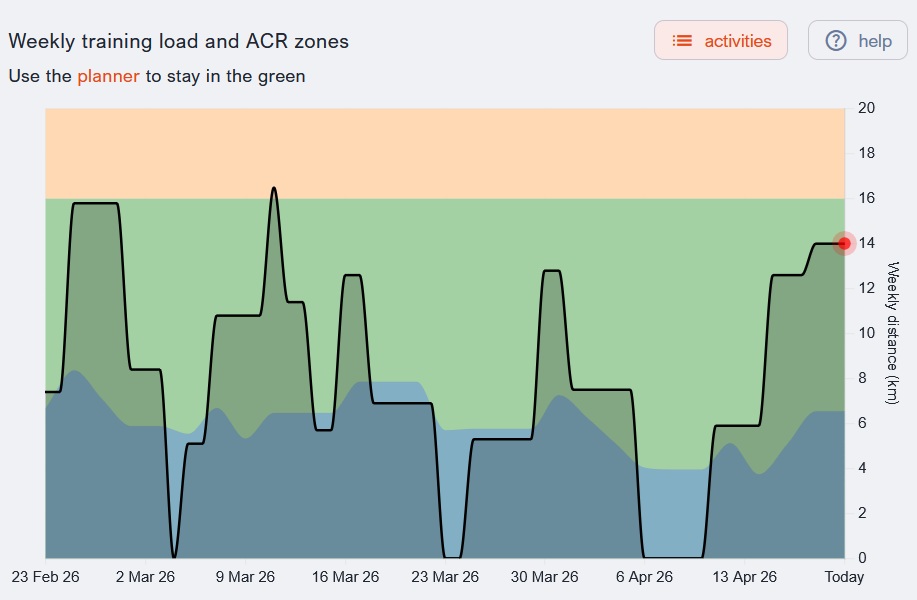
The conclusion provided by the paper: a runner can have a perfectly fine ACWR and still get injured due to a long run.
The study’s authors call this a “paradigm shift” and explicitly recommend moving away from ACWR as an injury prevention tool for runners.
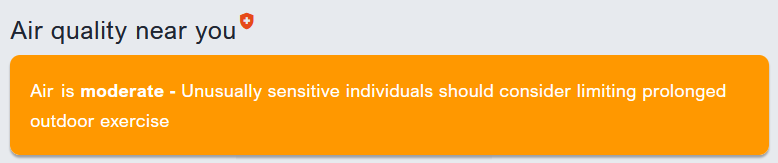
The app does have some nice additional features like air quality:
Platform: Web app (Strava only) | Free with premium option
Running injury rehab apps
These running injury apps offer strength, mobility, stretching, and rehabilitation programs. As literature showed, unsupervised exercise programs have not been proven to reduce injury risk or injury rate in endurance runners, but they can be useful once you are injured. For instance by managing existing symptoms.
Running injury rehab apps:
Recover Athletics (part of Strava)
Recover Athletics generates prehab routines of strength, mobility, and plyometric exercises. It uses an exercise library with videos and gives a simple way to do your (cool-down) routine, without having to search YouTube for stretches and exercises.
The soreness tracker is a nice feature, which helps you track soreness across multiple body areas over time.
It basically reacts to soreness you already have, rather than preventing it to happen. That’s not bad per se, as long as you’re aware that it is unlikely to prevent injuries from happening.
For those who already have Strava premium, it’s a nice add-on. If you’re not using Strava premium yet, I suggest you consider Exakt Health as your running injury rehab app.
Platform: iOS and Android | Included with Strava subscription (~€60/year)
Exakt Health
Exakt Health is probably the strongest rehab app available right now. It’s certified as a medical device in the EU. It offers 15+ injury-specific rehab plans for Achilles tendinopathy, runner’s knee, shin splints, plantar fasciitis, and more. Each plan is built by physiotherapists and progresses based on your pain feedback.
You need to know what your injury is, the app guides your rehab, but it doesn’t diagnose you.
Since Exakt doesn’t monitor running load, it’s best to pair this app with a load monitoring app, once you’re ready to return-to-run.
Platform: iOS and Android | 7-day free trial, then subscription
Return-to-run apps
During the return-to-run process, load management is crucial. You need to build gradually.
Building gradually means slowly increasing volume, frequency and pace – one at a time. Running injury apps that help you do that are the same as the ones that help you prevent running injuries. So jump to the running injury prevention apps section to learn more.
Running technique app
It’s unlikely that your running technique alone is causing you injuries. Most running injuries (up to 80%) are caused by running too much, too fast, too soon.
In many cases, you can run injury-free with a less-than-perfect running technique, as long as you build up gradually. Still it can be interesting to analyze your running technique.
Running technique app:
GaitLab
Gaitlab differs from the running injury apps covered so far. It turns your phone camera into a biomechanics lab. Film yourself running for 15-60 seconds, flag where it hurts, and the app analyzes your gait frame-by-frame.
It identifies things like overstriding, hip drop, cadence issues, crossover gait. Based on the diagnosis, it generates a corrective drill plan.
The limitation is the same as any technique app: running technique affects how load is distributed, not how much load you’re absorbing. You can fix your overstriding and still get injured if you run too far, too fast, too soon.
Platform: iOS and Android | Pay-per-analysis
Which running injury app is right for you?
Here’s a quick overview of all five apps:
| App | Category | Best for | Measures load? |
| Recover Athletics | Rehab | Post-run soreness routines | ❌ |
| Exakt Health | Rehab | Structured injury rehabilitation | ❌ |
| Molab Run | Prevention & return-to-run | Preventing injuries | ✅ Impact load on body |
| myTrainingForecast | Prevention | Load awareness on top of Strava | ⚠️ Distance only |
| GaitLab | Technique | Running technique analysis | ❌ |
If you’re returning-to-run or trying to prevent injuries, pick a ‘load management’ app: Molab Run or myTrainingForecast.
If you’re already injured, consider a ‘rehab’ app: Recover Athletics or Exakt Health.
60-80% of running injuries are caused by overload. Not poor form. Not weak glutes. Too much running, too fast, too soon.
That’s exactly what Molab Run is built around. Connect your running watch, and within minutes you’ll see your impact load, your single-session risk, your cadence trend, and exactly how far you can run today while staying in the safe zone.
Connect your watch and see your running data →

Founder Molab | Human Movement Scientist | Marketing & Education for Sport Tech companies